PPC
Why PMax Alone Is Not Enough in 2026 (And What to Combine It With)
On this page
Overview
- Introduction: The PMax Reality Check
- The PMax Landscape in 2026: What the Numbers Say
- 7 Critical PMax Limitations Every Advertiser Must Know
- Google's Power Pack: The 2026 Full-Funnel Framework
- PMax + Standard Shopping: The Hybrid Strategy That Wins
- Adding Demand Gen to Your PMax Mix
- AI Max for Search: The Missing High-Intent Layer
- Strategic Budget Allocation Across Campaign Types
- Implementation Roadmap: Building Your Multi-Campaign Architecture
- How PPC Software Bridges the Control Gap
- Frequently Asked Questions
- Why is PMax alone not enough for Google Ads success in 2026?
- What is Google's Power Pack strategy for 2026?
- Can I run Performance Max and Standard Shopping campaigns together?
- How many conversions does PMax need per month to work effectively?
- What percentage of budget should PMax get in a multi-campaign strategy?
- What is the average ROAS for Performance Max campaigns in 2026?
- How does Demand Gen differ from Performance Max?
- Conclusion
Introduction: The PMax Reality Check
Performance Max was supposed to be the future of Google Ads. One campaign type to rule them all — spanning Search, Shopping, YouTube, Display, Gmail, Discover, and Maps, all powered by Google’s machine learning. And for a while, it felt like that promise was coming true.
But here we are in 2026, and the reality is more nuanced. Over 73% of advertisers now run at least one PMax campaign, yet many of them are discovering the same uncomfortable truth: PMax alone leaves significant gaps in your paid media strategy. The advertisers seeing the strongest results aren’t the ones going all-in on a single campaign type — they’re the ones building intelligent, layered architectures where PMax plays a defined role alongside complementary campaigns.
This isn’t about abandoning PMax. It’s about using it correctly. In this guide, we’ll break down exactly why PMax can’t carry your entire Google Ads strategy in 2026, what to pair it with for maximum impact, and how to allocate budget across a multi-campaign framework that actually scales. Whether you’re an in-house marketer managing your own campaigns or an agency managing client accounts, these strategies apply to you.
The PMax Landscape in 2026: What the Numbers Say
Before we dive into what’s broken, let’s acknowledge what PMax does well. Performance Max now accounts for roughly 45% of all Google Ads conversions across the platform, and the average ROAS sits at approximately 4.1x. Those are strong numbers on the surface.
Key PMax Benchmarks (2026):
Average ROAS: 4.1x | Desktop conversion rate: 4.3% | Mobile conversion rate: 3.5% | Mobile CTR: 4.2% (20% lower CPC vs. desktop) | Minimum viable conversions: 30-50/month
But averages mask the real story. Advertisers who properly optimize and pair PMax with other campaign types see 20-35% improvements in ROAS compared to those running traditional structures. The delta isn’t coming from PMax itself — it’s coming from what surrounds it.
Over 60% of advertisers globally now use AI-powered campaign formats, and the shift isn’t toward consolidation into a single campaign type. It’s toward strategic diversification with AI at the core. The advertisers who understood this early in 2025 are now reaping the rewards. If you’re still running PMax as your only campaign, you’re leaving performance on the table.
7 Critical PMax Limitations Every Advertiser Must Know
1. Search Query Transparency Is Still a Black Box
This remains the most persistent frustration with PMax. You cannot see which search queries trigger your Shopping ads with any meaningful granularity. While Google made incremental improvements to search term reporting in 2025, the level of insight is nowhere near what you get from a dedicated Search or Standard Shopping campaign. For advertisers who need to understand customer intent at the query level — especially in competitive verticals like financial services or education — this is a significant blindspot.
2. Limited Channel-Level Budget Control
PMax automatically distributes your budget across all seven Google channels. Sounds efficient in theory, but in practice, it often means your budget bleeds into low-intent Display and Gmail placements when you’d prefer it concentrated on Shopping and Search. You still can’t set manual bid adjustments per channel. For ecommerce advertisers, this means your product feed budget might be partially diverted toward awareness placements you never wanted.
3. The Conversion Volume Threshold Problem
PMax needs data to learn, and the minimum bar is steep. Campaigns require at least 30-50 conversions per month to exit the learning phase and optimize effectively. Campaigns spending under $3,000 per month rarely generate enough conversion signals for the algorithm to make smart bidding decisions. This immediately disqualifies PMax as a standalone solution for small-to-mid-size advertisers, local businesses, or niche B2B accounts with lower volume. If you’re a local business relying on PPC, this threshold can be particularly challenging.
4. New Product Launch Blind Spot
PMax’s algorithm relies heavily on historical performance data. When you launch a new product, there is no history for the algorithm to reference. The result? Your best-sellers hog the budget while new launches struggle to get impressions. This creates a self-reinforcing cycle where established products get stronger and new SKUs starve, making PMax unreliable for product launches and catalog expansion.
5. Negative Keywords Only Partially Work
While you can add negative keywords to PMax, they only apply to Search and Shopping inventory. They have zero impact on Display, YouTube, Gmail, and Discover placements. This is a critical gap because much of PMax’s irrelevant traffic originates from these non-search channels. Without full negative keyword coverage, you’re paying for impressions and clicks that would never convert. Having a solid keyword strategy across complementary campaigns is essential to compensate.
6. Cannibalization of Your Own Campaigns
An analysis of 2,000 accounts found that 45% of PMax search terms also appeared in those same accounts’ Search campaigns. When PMax runs alongside other campaigns without careful architecture, it competes with your own ads rather than complementing them. This internal competition inflates your costs and muddles attribution, making it harder to understand what’s actually driving results.
7. The 6-8 Week Learning Tax
Every time you make a meaningful change to a PMax campaign — new asset groups, budget shifts, bidding strategy adjustments — the algorithm re-enters a learning period of 6 to 8 weeks. During that window, performance is volatile and often suboptimal. For businesses that need agility, seasonal advertisers, or anyone running frequent promotions, this learning tax is a real cost that compounds over time.
Google’s Power Pack: The 2026 Full-Funnel Framework
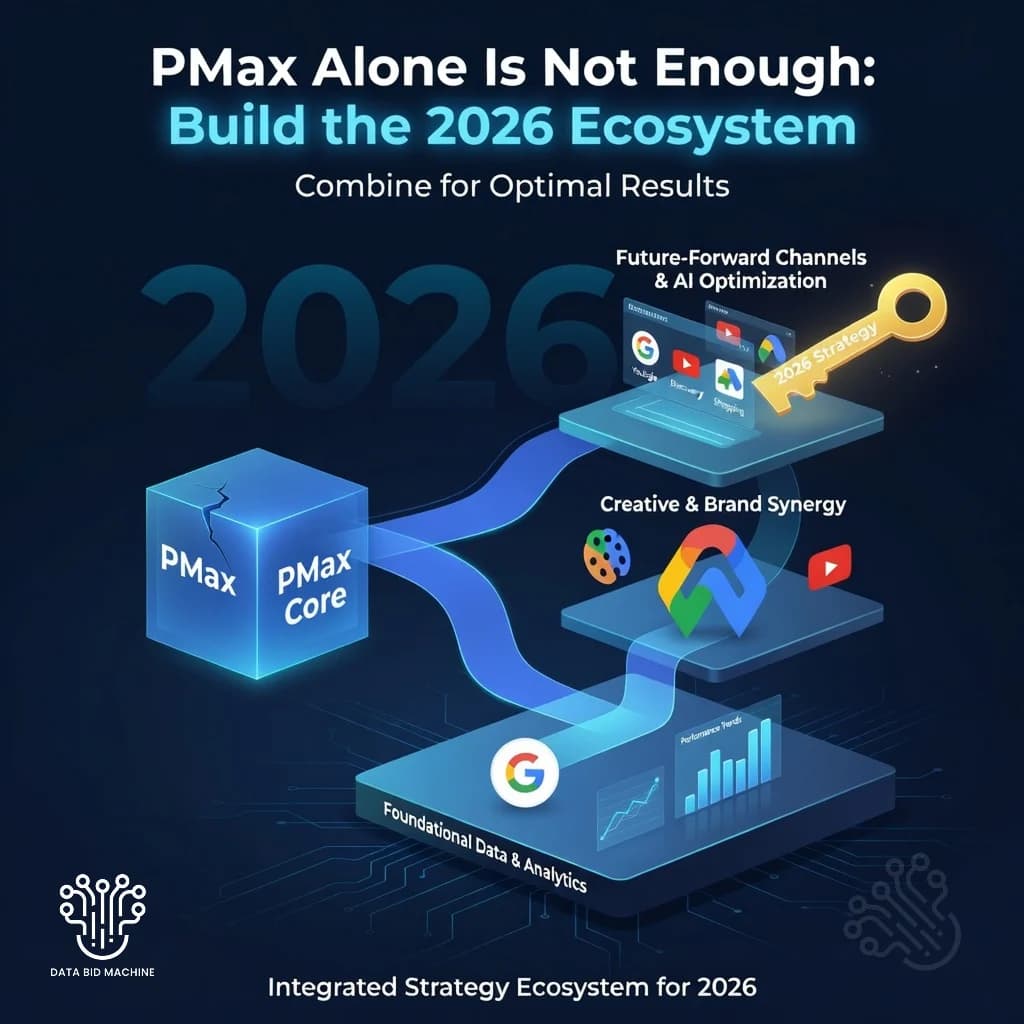
Google itself has acknowledged that PMax shouldn’t operate in isolation. Their recommended framework for 2026 is what they call the “Power Pack” — a coordinated three-campaign architecture designed to cover the entire customer journey.
The Power Pack consists of three interconnected campaign types, each handling a distinct phase of the funnel:
| Campaign Type | Funnel Stage | Primary Role | Key Channels |
|---|---|---|---|
| Demand Gen | Top-of-Funnel | Build awareness, warm cold audiences | YouTube, Gmail, Discover |
| Performance Max | Bottom-of-Funnel | Convert across all channels, maximize ROAS | Search, Shopping, YouTube, Display, Gmail, Discover, Maps |
Power Pack Impact: Early adopters of the three-campaign Power Pack framework are reporting 25-35% improvements in conversion rates compared to running PMax alone.
The logic is straightforward. Demand Gen fills the top of the funnel with qualified attention. AI Max for Search captures users during their active research phase with precise keyword targeting. Performance Max then converts those warmed-up audiences at the bottom of the funnel. Each campaign type does what it’s best at, rather than asking PMax to do everything alone. For advertisers looking for a deeper understanding of multi-channel digital marketing strategies, this framework represents a major strategic shift.
PMax + Standard Shopping: The Hybrid Strategy That Wins
Beyond the Power Pack, one of the most impactful combinations in 2026 is running PMax alongside Standard Shopping campaigns. This hybrid approach has become the go-to strategy among sophisticated ecommerce advertisers, and for good reason.
A pivotal change happened in October 2024: Google stopped automatically prioritizing PMax over Standard Shopping in auctions. Now, both campaign types compete on Ad Rank — the campaign with the higher ad rank wins the impression. This leveled the playing field and made the hybrid approach viable and powerful.
How to Structure the Hybrid
The recommended setup divides responsibilities clearly. Standard Shopping handles your high-value products where you need precise control — transparent bidding, product-level optimization, and detailed query-level data. Set Standard Shopping with a lower Target ROAS to ensure higher bids, which gives it higher ad rank and wins more auctions for your priority products.
Meanwhile, PMax runs at a relatively lower priority, acting as a discovery engine. It finds new audiences through YouTube and Display placements, explores new search queries, activates retargeting across Google’s properties, and captures incremental conversions your Standard Shopping campaign would miss. Think of PMax as the wide net and Standard Shopping as the spear.
This approach is especially effective when you need to launch new products (use Standard Shopping for control), protect branded queries (use Standard Shopping’s query transparency), and scale into new audiences (let PMax handle discovery). Understanding how search engines decide which ad to show can help you structure this hybrid more effectively.
Adding Demand Gen to Your PMax Mix
Demand Gen campaigns are the evolved version of Discovery Ads, and they solve one of PMax’s biggest weaknesses: controlled upper-funnel audience building. While PMax can technically reach users across YouTube, Gmail, and Discover, it does so in an automated, conversion-optimized way that often ignores users who aren’t ready to buy yet.
Demand Gen lets you deliberately invest in awareness and consideration with dedicated creative formats and audience targeting. The campaigns generate demand before users actively search, warming up cold audiences that PMax can later convert. This creates a compounding effect where Demand Gen feeds qualified traffic into PMax’s conversion engine.
Strategically, Demand Gen fills a gap that PMax cannot. It’s designed for visually rich, story-driven engagement — think YouTube Shorts, in-feed video, and Gmail immersive ads. These formats build brand familiarity that drives higher conversion rates when users eventually encounter your PMax ads. Early data shows that Demand Gen strategies can drive 40% or more additional conversions when properly integrated alongside Performance Max.
AI Max for Search: The Missing High-Intent Layer
AI Max for Search isn’t a new campaign type — it’s a suite of AI-powered features layered on top of your existing Search campaigns. Think of it as a major upgrade toggle that activates targeting and creative enhancements powered by Google’s machine learning. This is significant because it addresses one of PMax’s key limitations: precise control over high-intent search queries.
Where PMax handles search inventory as one piece of a broader cross-channel mix, AI Max for Search focuses exclusively on Search with enhanced AI capabilities. It expands your keyword reach intelligently, generates dynamic ad copy variations, and finds high-intent queries that your manual keyword lists might miss — all while giving you the control and transparency of a traditional Search campaign.
For advertisers running PMax alone, adding AI Max for Search means you capture high-intent queries with greater precision. PMax often competes with your Search campaigns for the same terms. By running AI Max for Search alongside PMax, you can segment intent more effectively: AI Max handles direct-intent queries where you want granular control, while PMax handles the broader cross-channel conversion path. The result is less internal competition and better overall efficiency. This is particularly valuable in sectors like B2B marketing where lead quality matters more than volume.
Strategic Budget Allocation Across Campaign Types
One of the most common questions advertisers face when moving beyond PMax-only is: how do I split my budget? The answer depends on your business model, but here are the recommended frameworks based on 2026 best practices.
For Ecommerce Brands
| Campaign Type | Budget Share | Rationale |
|---|---|---|
| Performance Max | 50-60% | Core conversion driver across all channels |
| Standard Shopping | 15-25% | Precise control for high-value and new products |
| Demand Gen | 10-15% | Upper-funnel audience building |
For B2B and Service Businesses
| Campaign Type | Budget Share | Rationale |
|---|---|---|
| Performance Max | 30-40% | Cross-channel reach and retargeting |
| Demand Gen | 15-20% | Thought leadership distribution and awareness |
| Standard Search | 10-15% | Brand protection and core keyword defense |
Some advertisers are seeing CPA advantages when keeping PMax limited to just 10-25% of total budget, especially in accounts with lower conversion volume. The key is to test allocations over 6-8 week cycles and measure incrementality, not just last-click attribution. Using the right analytics dashboards in your PPC software is essential for tracking performance across this multi-campaign setup.
Implementation Roadmap: Building Your Multi-Campaign Architecture
Moving from PMax-only to a multi-campaign strategy requires a phased approach. Rushing the transition will tank your performance as algorithms reset and learning phases overlap. Here is a pragmatic 8-week roadmap.
Weeks 1-2: Audit and Baseline
Start by auditing your current PMax performance at the asset group level. Identify which channels are consuming the most budget (use placement reports), which search terms are driving conversions, and where there’s overlap with any existing Search campaigns. Document your current CPA, ROAS, and conversion volume as baselines. This is also the time to ensure your responsive search ads are optimized before layering in AI Max.
Weeks 3-4: Launch Standard Shopping Alongside PMax
If you’re in ecommerce, introduce a Standard Shopping campaign targeting your top-performing product categories. Set a lower Target ROAS than PMax to give Standard Shopping higher bid priority. Don’t pause PMax — let both run concurrently and monitor which campaign wins which auctions. Watch for any campaign challenges and address them early.
Weeks 5-6: Introduce AI Max Settings for Search
Enable AI Max features on your existing Search campaigns, or launch new Search campaigns with AI Max activated. Focus on your highest-value keyword themes first. Add negative keyword lists to PMax for queries you want AI Max for Search to own exclusively.
Weeks 7-8: Activate Demand Gen
Launch your Demand Gen campaigns with upper-funnel creative assets — video, lifestyle imagery, and brand storytelling. Start with 10-15% of total budget. Set up audience segments that feed into PMax’s remarketing pools. Measure view-through conversions and assisted conversions, not just direct attribution.
How PPC Software Bridges the Control Gap
One of the biggest challenges of managing a multi-campaign architecture is maintaining visibility and control across campaign types that each have different reporting structures, optimization levers, and learning phases. This is where dedicated PPC management software becomes essential — not optional.
The right PPC automation software helps you monitor cross-campaign performance in a unified dashboard, identify cannibalization between PMax and your Search or Shopping campaigns, automate bid adjustments based on real-time ROAS targets, and generate unified PPC reports that tie multi-campaign strategies back to business outcomes.
Without PPC software providing that orchestration layer, you’re flying blind across four different campaign types. The complexity of managing Performance Max alongside Standard Shopping, AI Max for Search, and Demand Gen demands tooling that can see the full picture and act on it.
Struggling to Manage PMax Alongside Other Campaigns?
DataBid Machine gives you the unified view and automation controls to orchestrate multi-campaign Google Ads strategies — so PMax works with your other campaigns, not against them. Explore DataBid Machine
Whether you choose DataBid Machine or another solution, the principle holds: PPC automation software is no longer a nice-to-have. In a multi-campaign world where PMax is just one piece of the puzzle, software-driven management is how you maintain efficiency and scale without burning budget.
Frequently Asked Questions
Why is PMax alone not enough for Google Ads success in 2026?
PMax alone is insufficient because it lacks search query transparency, offers limited control over channel-level budget allocation, requires at least 30-50 conversions per month to optimize, and struggles with new product launches due to missing historical data. A hybrid approach combining PMax with Standard Shopping, Demand Gen, and AI Max for Search delivers significantly better conversion rates.
What is Google’s Power Pack strategy for 2026?
Google’s Power Pack is a full-funnel framework combining three campaign types: Performance Max for bottom-funnel conversions (typically 50-60% of budget for ecommerce), AI Max for Search to capture high-intent queries (30-40% of budget), and Demand Gen for upper-funnel awareness (10-20% of budget). Early adopters report 25-35% improvements in conversion rates versus PMax alone.
Can I run Performance Max and Standard Shopping campaigns together?
Yes. Since Google’s October 2024 policy change, PMax no longer takes automatic priority over Standard Shopping. Both compete based on Ad Rank. The recommended hybrid setup uses Standard Shopping with a lower Target ROAS for priority products (giving it higher bids and winning more auctions), while PMax handles audience discovery and cross-channel reach.
How many conversions does PMax need per month to work effectively?
PMax requires at least 30-50 conversions per month to exit its learning phase. Campaigns under $3,000/month in ad spend rarely generate enough signals. Plan for a 6-8 week learning period before evaluating results. If your conversion volume is below this threshold, consider advanced PPC strategies that use complementary campaign types to supplement PMax.
What percentage of budget should PMax get in a multi-campaign strategy?
For ecommerce, PMax typically receives 50-60% of budget. For B2B and services, 30-40%. Some advertisers see CPA advantages keeping PMax at 10-25% of total budget, distributing the rest across Standard Shopping, AI Max for Search, and Demand Gen based on funnel goals. The right split depends on your conversion volume and business model.
What is the average ROAS for Performance Max campaigns in 2026?
The average ROAS for PMax in 2026 is approximately 4.1x. However, this varies significantly by vertical, budget level, and whether PMax runs standalone or as part of a hybrid strategy. Advertisers running multi-campaign architectures typically outperform single-campaign setups by 20-35% on ROAS.
How does Demand Gen differ from Performance Max?
Demand Gen focuses on upper and mid-funnel awareness across YouTube, Gmail, and Discover, warming up audiences before they actively search. PMax is a full-funnel conversion engine across all Google channels. In the Power Pack framework, Demand Gen creates brand familiarity that boosts PMax’s conversion rates downstream. Together, they can drive over 40% more conversions than either campaign type alone.
Conclusion
PMax remains a powerful campaign type in 2026 — but it was never designed to be your entire strategy. Its limitations in query transparency, channel control, conversion volume requirements, and new product support make it fundamentally insufficient as a standalone solution.
The advertisers winning right now are the ones treating PMax as one component of a deliberate multi-campaign architecture. Whether you adopt Google’s Power Pack framework (PMax + Demand Gen + AI Max for Search), run the PMax-Standard Shopping hybrid, or build a custom combination tailored to your vertical, the principle is the same: diversification with intention.
Start by auditing your current PMax performance, identify the gaps, and layer in complementary campaigns over an 8-week phased rollout. Use PPC management software to maintain visibility across your expanded campaign structure. And remember — the goal isn’t more campaigns for the sake of complexity. It’s about putting the right campaign type in front of the right user at the right stage of their journey.
PMax is a great closer. But in 2026, it needs a team around it.